
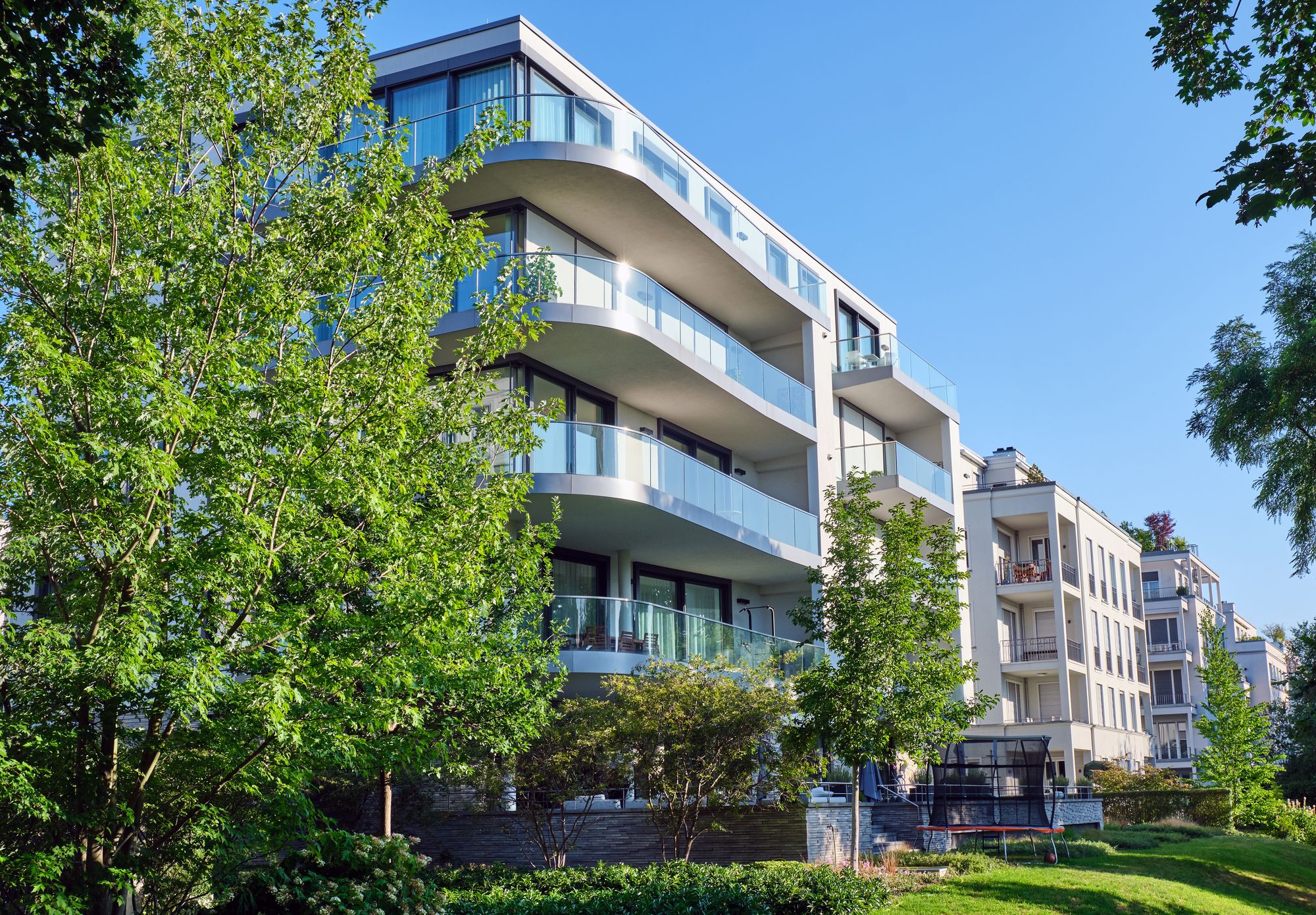
In summer, owners and tenants often spend a great deal of time in the garden, on the patio or on the balcony. When children play outside, things can sometimes get louder – and the same applies to barbecues and other celebrations. The Wohnen im Eigentum (WiE) consumer protection association explains how much noise neighbours have to tolerate and where the limits lie.
When is noise permitted, and when does it become excessive? Some residents value peace and quiet, while others enjoy celebrating. Children shouting and dogs barking can also divide many a condominium owners’ association (WEG) or neighbourhood. The Wohnen im Eigentum consumer protection association advises owners to speak to the person causing the disturbance first whenever a conflict arises and to try to find a mutually acceptable solution. “Living together harmoniously in the long term is more important than prevailing in the short term,” says Dr Sandra von Möller, a member of the WiE board.
Statutory quiet hours
As a general rule, Germany’s federal states set quiet hours in their state-level pollution control legislation; a general night-time quiet period from 22:00 to 06:00 on weekdays is customary. Some local authorities also specify a midday quiet period. Blocks of flats and condominium owners’ associations often have house rules governing quiet hours. These house rules may differ from the statutory provisions and may also impose stricter requirements. The WEG management is responsible for enforcing them. Loud activities such as drilling or mowing the lawn must be avoided during quiet hours. Conversations, television and music at normal room volume, however, are permitted.
Motorised garden equipment
Unless the house rules provide otherwise, motorised equipment such as lawnmowers and hedge trimmers may be used only between 07:00 and 20:00 on weekdays. This is laid down in the Equipment and Machinery Noise Protection Ordinance. Even stricter rules apply to particularly loud equipment such as leaf blowers and grass-edge trimmers: these may be used only between 09:00 and 13:00 and between 15:00 and 17:00 on weekdays.
Barking dogs and noisy treadmills
Barking dogs are another recurring source of disputes between neighbours. Occasional barking does not constitute a material noise nuisance, but excessive or persistent barking, particularly during quiet hours, may result in a fine. As it is not possible to train every animal out of excessive barking, structural soundproofing measures may be considered as an alternative.
Exercise at home can also disturb others in blocks of flats. Yoga on a floor mat is unlikely to cause a problem, but equipment such as steppers is another matter. Some treadmills can produce as much as 75 decibels, equivalent to a washing machine on its spin cycle. Impact sound insulation must be considered, and a special floor mat or carpet may need to be laid. Incidentally, neighbours’ intimate encounters also have their limits. Neighbours do not have to tolerate loud noises during sexual activity or loud cries of “Yippee”, even during the day (Warendorf Local Court, judgment of 19.08.1997, case no. 5 C 414/97).
Noise from children need not be tolerated without limit
Residents with and without children often have different interests. As a general rule, other residents must be tolerant when children play and romp about, but not without limit (Federal Court of Justice decision of 22.08.2017, case no. VIII ZR 226/16). This covers behaviour that is normal for a child’s age: young children cannot be expected to observe the usual quiet hours, whereas the position is different for older children. Parents also have a duty here. Typical noise from children, such as shouting, laughing and romping while playing, babies and toddlers crying at night or occasional stamping by children, cannot be objected to. However, residents do not have to accept, for example, a child repeatedly throwing a ball against a wall over an extended period.
No ban on playing music, but reasonable time restrictions are permitted
What is permitted when playing music at home depends on the individual case; relevant factors include the location, the way the instrument is played and the nature of the resulting noise. According to Federal Court of Justice case law, a reasonable guideline is two to three hours on weekdays and one to two hours on Sundays and public holidays, irrespective of whether the person is a professional or amateur musician. The usual midday and night-time quiet hours must always be observed. A general ban on playing music in a rented flat is invalid (Federal Court of Justice, judgment of 26.10.2018, case no. V ZR 143/17).
What owners and tenants can do
If the person causing the disturbance remains uncooperative despite being approached politely and the noise nuisance continues, neighbours have the following options:
- Notify the local public order office: a noise nuisance may be punishable by a fine of up to 5,000 euros (Section 117 of the German Administrative Offences Act).
- Seek a civil-law injunction under Section 1004 of the German Civil Code: sometimes a letter from a law firm is sufficient and court proceedings can be avoided.
Owners who let their property are also required to ensure that noise affecting their tenants is stopped – otherwise, tenants may even reduce the rent (Section 536 of the German Civil Code).
Keep a noise log
“As a general rule, it is helpful to begin by keeping a noise log over a certain period so that the alleged disturbance can be proved,” advises Dr Sandra von Möller. One of the requirements for a noise nuisance is that the sounds occur repeatedly.